
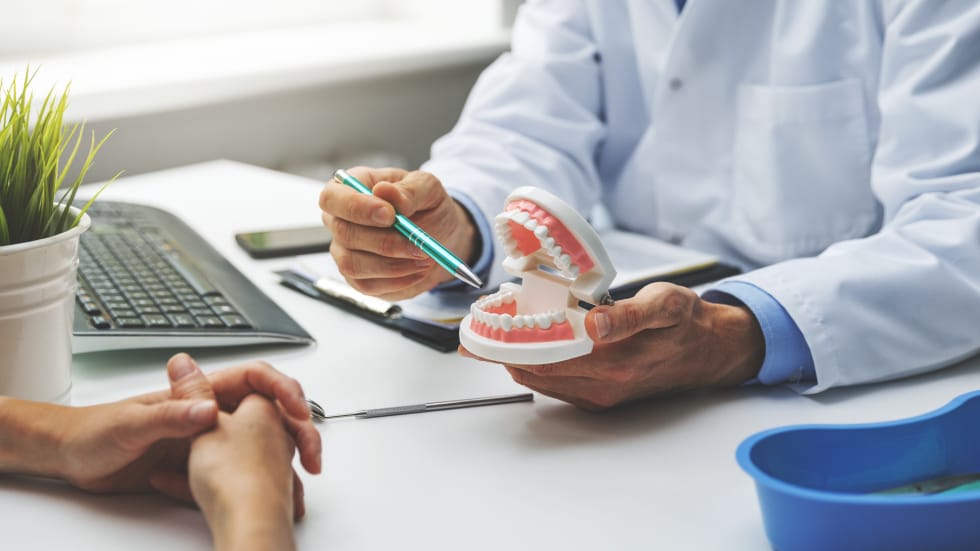
Multiple missing teeth are usually handled well by dentures, which are more affordable upfront, while better stability and bone preservation are offered by dental implants but cost more initially. Budget, jawbone health, and how many teeth need replacement often determine the right choice. For personalized guidance, visit our website to explore your options.
Fast Facts:
- Dentures typically cost $1,200-$3,000 per arch, while single implants range from $3,000-$5,000
- A 95% success rate over 10 years is achieved by dental implants
- Complete dentures can be ready in 4-6 weeks, implants take 3-6 months
- Some form of denture is worn by about 40% of adults over 65
- Implants can last 25+ years with proper care
Understanding Your Options
More than just your smile is affected by missing teeth. How you eat, speak, and feel about yourself gets impacted. These problems are solved by both dentures and dental implants, but completely different approaches are taken. Missing teeth are replaced with removable prosthetics by dentures, while artificial tooth roots are surgically placed with implants. Your daily routine for years to come gets shaped by the choice between them.
How Dentures Work
Directly on your gum tissue is where traditional dentures rest; suction and adhesive hold them in place. Your mouth’s unique shape and your remaining teeth’s color are matched when they’re crafted. All teeth in an arch are replaced by complete dentures, while gaps between existing teeth are filled by partial dentures. Several fittings over 4-6 weeks are typically involved in the process. How quickly their smile can be restored with this option is appreciated by many Oshawa patients.
The Implant Process
A titanium post surgically placed into your jawbone is how dental implants start. The bone grows around this post over 3-6 months in a process called osseointegration. A crown is attached once healed to complete the restoration. Your jawbone is preserved by this approach, and the most natural-feeling replacement is provided. Decades of reliable function often justify the investment in time and money.
Cost Considerations
A major role in most decisions is played by budget. Less upfront cost is typically required by dentures, ranging from $1,200 to $3,000 per arch depending on materials and complexity. A larger initial investment is required by implants, often $3,000 to $5,000 per tooth. However, replacement is rarely needed for implants, while adjustments, relines, or complete replacement every 5-10 years may be required by dentures. In a way, implants can actually be favored by the long-term math.
Daily Life Impact
When choosing between options, your lifestyle matters. Daily removal for cleaning and overnight soaking is required by dentures. Difficult eating and speaking practice may be needed for some foods. Like natural teeth, implants function, allowing you to eat whatever you want; regular brushing and flossing cleans them. But healthy gums and sufficient jawbone are required for successful placement.
Making Your Decision
Your specific situation determines the best choice. Age, bone density, overall health, and personal preferences all factor into the recommendation. Both treatments are even combined by some patients, using implants to secure dentures for improved stability. Which option suits your needs and goals is determined by a thorough examination. Your case can be evaluated by our team at King Ritson Dental Clinic, and all available options can be discussed. Visit our website to schedule a consultation and explore the right solution for your smile.
Mini-FAQ:
Q: Do dentures feel natural when eating? Better fit is provided by modern dentures than older versions, but they’ll never feel exactly like your natural teeth. Sticky or hard foods can still be challenging. Adaptation occurs within a few weeks for many patients, though some foods remain off-limits.
Q: How painful is getting dental implants? The discomfort is described by most patients as similar to a tooth extraction. Local anesthesia is used during the procedure, and any soreness afterward is managed by pain medication. Honestly, the anticipation is often worse than the actual experience.
Q: Can I sleep with my dentures in? Look, technically you can, but removal at night is recommended by dentists. Time to rest and recover from the pressure is needed by your gums. Plus, overnight soaking helps keep the dentures clean and properly shaped.
Q: Will insurance cover either option? Fair point to ask upfront. A portion of dentures is covered by most dental insurance, typically 50-80% after deductibles. Implant coverage varies widely; some plans cover the crown but not the implant itself. That still surprises people.